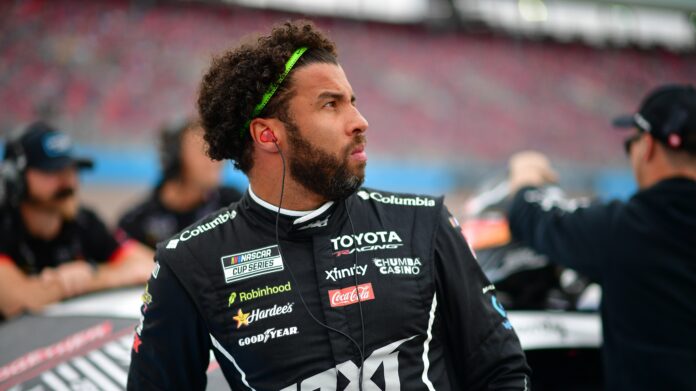
Bubba Wallace just can’t seem to have a quiet week in NASCAR, even when he isn’t breaking any rules. A blunt radio message at Talladega regarding assistance to teammate Tyler Reddick sparked renewed debate over Wallace’s attitude and driver obligations. Some fans labeled him selfish, whereas others claimed he was entitled to safeguard his own race.
The Radio Message That Sparked It All
The existence of the criticism is explained by this. However, a significant difference separates questioning a driver’s decision from treating one frustrated radio message as proof of his entire character. Freddie Kraft, Wallace’s spotter, publicly challenged the characterization of the exchange. He contended that Wallace’s frustration stemmed from a dangerous on-track situation, not merely a refusal to help Reddick. The controversy that refuses to end gained another layer due to that dispute.
Wallace possesses a large following alongside an equally vocal group of critics. Each controversial moment becomes another referendum on whether he deserves his place in NASCAR. His supporters sometimes dismiss legitimate criticism too quickly, while his detractors treat every mistake as confirmation of everything they already believe. Neither approach creates particularly good racing analysis. Wallace must be held to the same standards as every Cup driver. It involves offering him credit when he earns it while also criticizing mistakes when he makes them.
Why The Rules Matter More Than The Drama
While fans argue over radio messages, officials are looking at the actual lines on the track. NASCAR reviewed multiple camera angles before deciding Kyle Larson did not break the yellow-line rule. Brad Moran, the Cup Series Managing Director, outlined the criteria NASCAR applies to determine if a driver warrants a penalty. “You have to have your two left-side tires clearly below the yellow line to be penalized,” he said, according to Yahoo Sports. Larson kept his victory after officials ruled his No. 5 Chevrolet stayed within the boundary.
“We also looked at the No. 1 and the No. 77. They were below the line just at the exit of Turn 4,” Moran said. NASCAR viewed those incidents as accident avoidance because the No. 34 car was moving down the track. “We called that one basically accident avoidance. The No. 34 was coming down, and we called that part of racing,” Moran explained. They felt the call was necessary to prevent a wreck when it was that close to the checkered flag.
Fans must determine what occurs on the track instead of reaching a verdict before the race starts. Talladega gave everyone another reason to argue, but the rules are clear. “If you clearly drive down below the double yellow lines to advance your position or make a pass, you’ll be penalized,” Moran said. Martinsville will provide the next test for everyone involved.